Blog

the rain came down and the flood came up!

Leaving Hoedspruit was odd. At the end of a holiday one usually goes home to pick up your normal life. One of joy, care, responsibility, maintenance, comfort and familiar things. We however headed off along familiar roads to a place we know well but with our tortoise shell trundling along behind us – regular Gipsies!

This slideshow requires JavaScript.

Ngata Safari Lodge https://ngatasafari.co.za/ welcomed us and we managed to get the van onto the site facing in our chosen direction. The few times we have moved the van by hand we have maneuvered it sideways. A surprisingly easy thing to do considering it is a dead weight exceeding 1700kg’s. We confidently placed wood under the jockey wheel to push it forward the required 1m. We pushed. And pulled. And pushed. Without success. It did not even move 1cm! Realizing we were not going to win the fight we re-hitched the car and pulled the van with the car (yes, that’s the normal way to move a caravan..) so that it is parallel to the fence with a perfect view of the bush.

When we packed up the tent the last time we used insulation tape to colour code the poles. Putting up the first awning was a sinch and we were settled and having coffee in short order.

After a bit of shopping the following day we confidently unpacked the full tent and the add-on 2×2 and began the jigsaw puzzle. After about two hours in the blazing sun working out where BL pole and O pole met with BK pole we were tired but not unhappy. The next step was putting up the varanda roof which looked a little odd but we forged ahead. As we got to the final stages we realized that we had put the roof on upside down! We called time out and went for a swim and although we had a good laugh at our inexperience and silliness we could still admire the way the van looked with its tent on.

Later that afternoon we were able to relax. All our plans in place and the reality very pleasant and larger than we expected.

The following day we settled in, sorted out my ‘office’ and prepared to welcome our first guest for sundowner drinks. I was able to bake sausage rolls and found working in the outdoor kitchen very pleasant. A gentle patter of rain accompanied us to bed.

Rain, wind, thunder and lightning. About 38mm of rain. Water streaming under the van covered my feet when I went to check on the tent. Realizing that there was nothing I could do in the event of a disaster we snuggled down to relish the elements out of control and left the van, tent and contents to look after themselves.

Waking up for morning coffee we were surprised and most pleased to find that we had weathered the storm relatively unscathed. The water running under the van is the result of geography and not our incompetence. One window had not been fully closed causing some dampness but on the whole we made it through the night!

We still have a lot to learn about expert tent erection but it will come in time.

Work was waiting for us and the year has begun well.
a rainy day road trip

img_0602

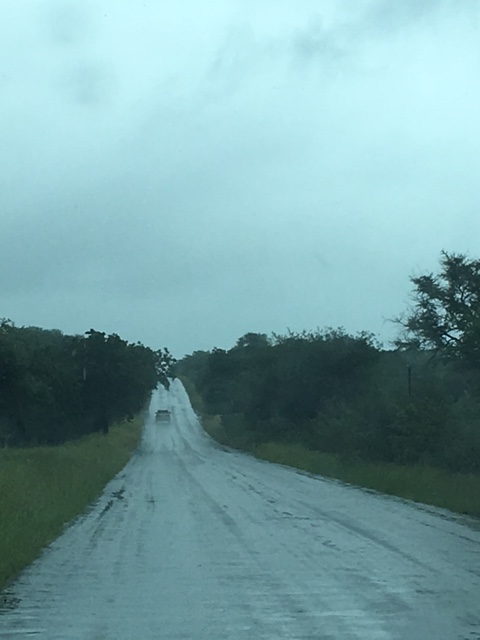
We woke up to rainy weather and low clouds – the perfect weather for a road trip to Klaserie Caravan Park that we have been meaning to visit since our arrival. The scenic route via Orpen Gate called and we set off with a picnic lunch to explore the bushveld at its best. The many Maroela trees along the roads are heavily laden with fruit; I hope they are a good indicator of an abundant rain year ahead. Water is lying next to the road and dry river beds have small trickles starting to move down their courses. A huge police roadblock and many security vehicles a grim reminder of the rhino war also being fought this close to Kruger. Having Hatchico in the car meant that we could not go into the park but we explored a side road that looked interesting and ended up at ‘The Wild Olive Tree Camp’. Their website intriguing ‘Whilst you listen to the elders telling their stories at the campfire, in the distance you can hear the cow bells of the cattle returning home signaling the end of the day and at the same time hear the hyena calling and the lion roaring telling you that the wilderness has woken up.’ http://wildolivetreecamp.co.za/camp.html  They welcomed us with many smiles and assurances that our dog could walk the short trail to the river and back with us as there were no wild animals. We set off under a glowering sky to walk the short 2km trail that had been established by one of the staff. Many birds accompanied us calling from the undergrowth while cattle bells rang in the distance. About 1km into the walk I got the distinct feeling that I was growing taller! Within 50m the clay collecting on our sandals was making it slow going – Even Hatchi was collecting mud shoes on all four feet. As soon as the soil changed we were able to scrape the mud off our shoes while Hatchi miraculously ended up back at the car park with clean feet (still not sure how she does that). We put our shoes into rubbish bags and drove back to the main road to find a puddle. We got many strange looks from passers by as we cleaned both feet and shoes in the drizzle. Further down the road a young elephant bull grazed just inside the Timbavati fence. The cow bells in the background emphasizing the veld utilization of game to the right of us and cattle to the left. We found a spot overhung with beautiful trees to enjoy our picnic lunch while wondering around a grave site (I am not sure why they recorded three dates on the grave stones – birth, death and internment?) After lunch we drove off towards a group of men, boys and dogs jumping in and out of a deep puddle alongside the road. I was horrified to see they were collecting bullfrogs on a metal spike. With huge grins they assured us that the frogs were a delicacy that were much anticipated in the rainy season.
Driving out towards Acornhoek we were entertained by the many signs displayed – a school ‘Acorns to Oakes’. A shop ‘Smokers Welcome’. ‘Hazy Funeral Undertaker’. ‘Rolla Coster Public Works’. We admired the outhouses; plastered and painted with tiled roofs finished off with gutters to ensure visitors could use the facilities in relative comfort!
After surviving an hour long traffic jam on potholed roads you would not like to travel at night we passed through Acornhoek and arrived at the Caravan Park. Their attitude was not welcoming although the stands around the dam itself were inviting.
We drove back to base with Hatchico’s sopping wet face still smelling the breeze outside the car window.

handing over the keys

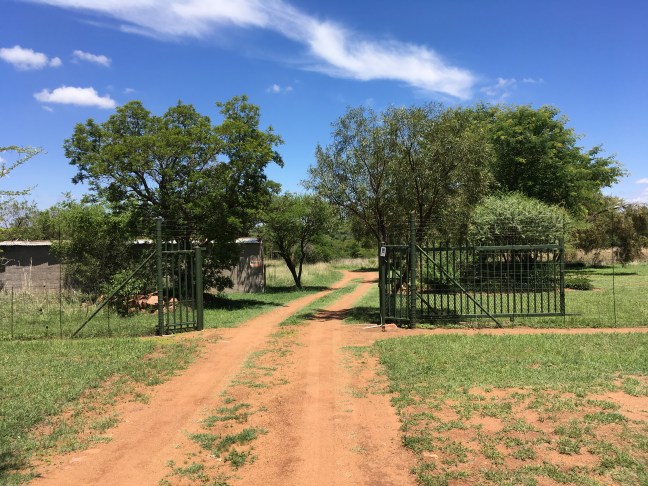
img_8594We left Mom’s house in Modderfontein early to give ourselves some ‘alone time’ at the farm before the new owners arrived at 11 o’clock. Clive was driving the new Toyota Hilux D4D for the first time and enjoying it! We arrived, opened the house, checked the pool, pumped water into the jojo tank and wondered down to the dam. We were excited to see otter scat and two white-faced ducks. Walking down to the river the glorious spring green glowed around us in the early morning light. Clive and I spent some time pausing at the river where I have spent so many happy hours, took a few photos and left will full hearts. The new owners, Attie and Angie Maleka had also arrived early and we greeted them before Clive left to collect our garden manager, Able Mafa, to introduce him to the Maleka family who plan to keep him on for a month or two while they learn the ropes. I walked the family around explaining how to get water to the various jojo tanks, how to water the garden, where the pipes are underground, how to switch things on or off – the many details of life on the farm. The koi came to the surface of the top pond to feed delighting us all. We collected at the dam while Clive and Mafa went to turn the river pump on to demonstrate how the garden sprinklers worked. While we waited for the water I bent down to weed out Syringa  seedlings (http://www.invasives.org.za/legislation/item/279-syringa-melia-azedarach)  that had sprouted and Attie’s brother, who will be living at the farm for a while, recognized the tree and we companionably weeded these unwanted plants for a while discussing the menace of these and other invasive plants on the South African ecology. Later in the morning Angie and I sat on the step in the lounge discussing her work as a school nurse and her plans for decorating the farm. After Hatchiko had had a last swim in the dam and dried off we took our goodbye’s and drove out of the gate for the first time in over 17 years with no controller to close it behind us.

‘To be, or not to be’


The long and the short of all of this is that all the measurements and the weights from the books that we have been working to; what the caravan manufacturer says it’s tare and its GVM is and what the vehicle we bought is capable of towing have not worked out as expected. (Definitions at the end of the blog) The vehicle is fine but the GVM of the caravan (a customized Jergens Clasique with an external kitchen) has been weighed at the weigh bridge today and the tare has come in at 1450kg’s and the GVM is 1495. Which means we only have 45kg’s that can be loaded into the caravan.  Bearing in mind that this load includes all our clothes and other worldly possessions we understood immediately that we have a huge problem on our hands even before we take possession of our caravan

The book says the Clasique has a tare of 1266kg’s with an expected GVM of 1495. Which would have given us 229kg’s for clothing, groceries, kitchen equipment etc that would travel inside the caravan.  The tent and spare wheel would travel in the Toyota Legend 40 which has a tare of 1850kg’s – in order to be able to break safely the vehicles tare must be equal or greater than the caravans GVM. We can load the vehicle to maximum capacity, which decreases its fuel efficiency, but we can load very little into the caravan as it stands now  (I have the clean shirt on Monday, Wednesday and Friday. Clive can have it on Tues, Thursday and Saturday.  Sunday is the shirt’s day off)

The caravan supplier, Kempton Caravans  is now assisting us to work out why.  Why are the spec’s so different from those advertised? Where has all the weight come from?

The first step will be to check the weighbridge calibration to ensure that it is accurate. Kempton Caravans are going to weigh a standard Clasique to ensure that it is the advertised weight. We will look at upgrading the axel, tires and rims to bring the GVM as close to 1800kg’s as possible. An exercise that will probably take another week. During this time we will also check the tow hitch and ensure that it is capable of towing the increased load.

Although we left the supplier with our heads spinning we were both amazed at how good the van is looking and even the franchise owner said that it looks like something out of a magazine.

—————————————

Tare weight /ˈtɛər/, sometimes called unladen weight, is the weight of an empty vehicle or container. By subtracting it from the gross weight (laden weight), the weight of the goods carried (the net weight) may be determined.

The gross vehicle weight rating (GVWR), or gross vehicle mass (GVM) is the maximum operating weight/mass of a vehicle as specified by the manufacturer including the vehicle’s chassis, body, engine, engine fluids, fuel, accessories, driver, passengers and cargo but excluding that of any trailers.

GA or Gross axel weight rating is the specific weight determined by the manufacturer to be the maximum allowable weight that can be placed on an individual axel

From the website  Eyershitch – The maximum trailer weight a specific axle is designed to carry is the GROSS AXLE WEIGHT RATING (GAWR). Again, the rating represents the empty vehicle’s axle weight plus the maximum added load. The total of the axle loads plus the tongue weight must not exceed the GVWR

Your load consists of the empty trailer itself, plus weight added in the form of water, food, clothing and anything else that may be stored in or attached to the trailer. The maximum load for which the trailer is designed is called the GROSS VEHICLE WEIGHT RATING (GVWR). This is the total of the weight on the axles and weight on the trailer tongue.

Tongue weight is simply the downward force that the tongue of the trailer exerts on the hitch that is connected to the vehicle. An acceptable tongue weight for any trailer is somewhere between 9 to 15 percent of the gross trailer weight (GTW).

A message from Clive

“Just been thinking my babe, while you walking, think of this – we pack up everything, cut the ties and go to the coast.  Just think – we are holding on and maybe need to take the bull by the horns and get going.  It will work out like it always does.  We must just trust and keep going”

Just Do It and correct course along the way